
What Low-Voltage Terminals Do in an EV Harness
Time : September 10, 2026 View : 264
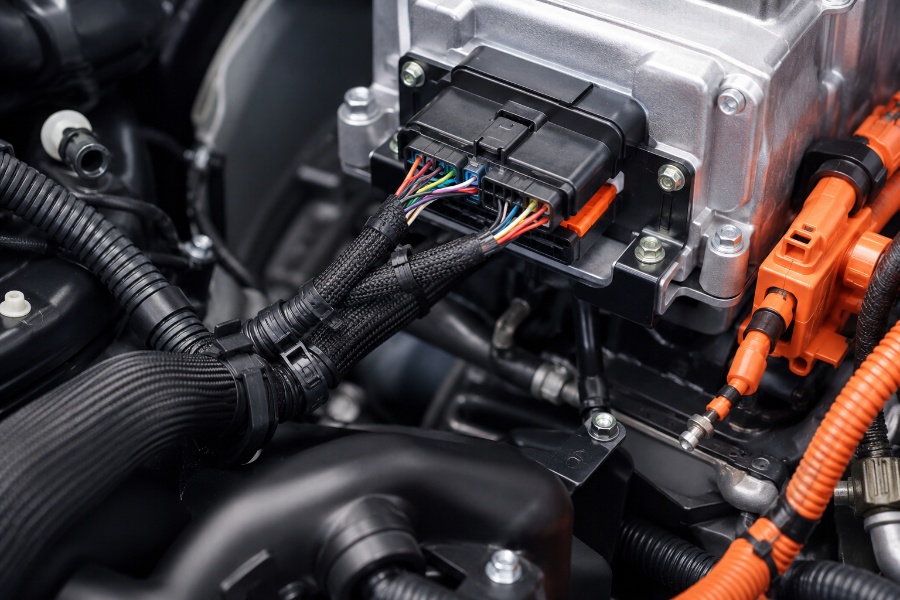
A vehicle can have a sound traction circuit and still suffer from a frustrating electrical fault: a sensor disappears after a bump, a command arrives intermittently, or a warning is triggered only in wet weather. These faults often live at the low-voltage terminal, where a small contact has to keep a control or sensing path complete in a demanding vehicle environment.
Low-voltage terminals are the handoff points for control
Low-voltage circuits carry the information that allows vehicle modules to coordinate. They can connect sensors, control units, actuators, charging communication, and auxiliary functions. A terminal is the engineered handoff between the conductor and the mating interface, so its quality affects whether the signal has a stable path rather than simply whether two parts can be plugged together.
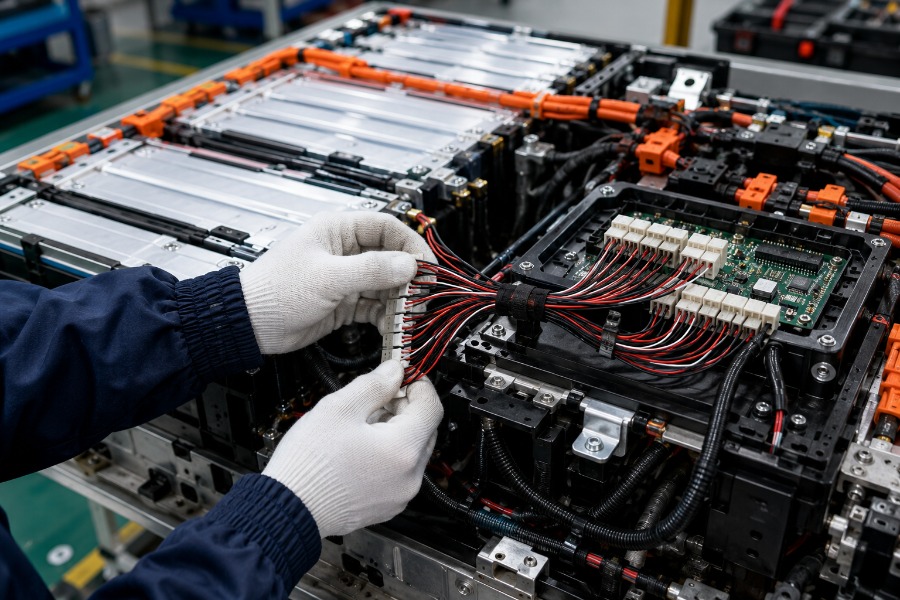
That makes a new energy vehicle high and low voltage wiring harness a system of different responsibilities. The high-voltage branches move energy between the battery, inverter, motor, and charging hardware. Low-voltage branches convey the control and measurement information that helps those systems operate together. Neither role should be evaluated with the other role’s checklist.
A broader new energy vehicle wiring harness view makes that split clear before individual terminal choices are made.
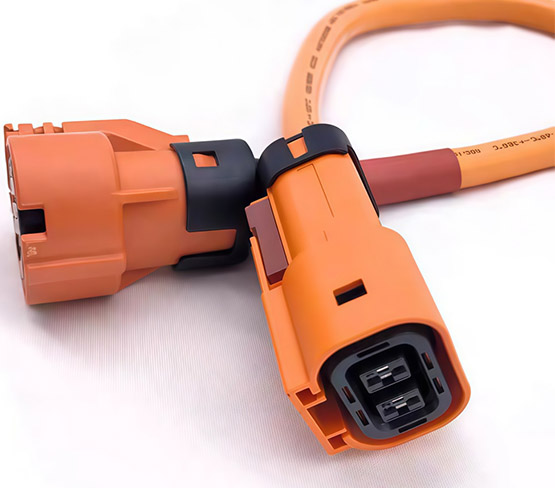
A terminal has to do three jobs at once
A good terminal maintains electrical contact, stays mechanically retained, and remains protected in its operating environment. These duties interact. A crimp that has the right electrical result on a bench can still become unreliable if the conductor is pulled, the housing does not latch fully, or vibration works against the terminal support.
|
Terminal duty |
Question to ask at the vehicle interface |
Typical consequence if missed |
|
Electrical contact |
Does the conductor and terminal form a stable contact path? |
Intermittent sensor or control signal |
|
Mechanical retention |
Can vibration, routing load, or service handling move the terminal? |
Backed-out terminal or unstable connection |
|
Environmental protection |
Does the interface suit moisture, dust, heat, and nearby fluids? |
Corrosion, short circuit, or insulation damage |
The crimp is only one part of the connection
Crimp quality matters because it joins the conductor to the terminal, but it is not the whole terminal decision. Wire size, strand construction, insulation diameter, terminal geometry, housing cavity, and the application’s pull direction all influence whether the finished connection behaves as intended. Matching only the terminal’s appearance is a common source of avoidable rework.
Retention starts with the wire exit
A terminal sees load through the wire before a technician notices any movement at the connector face. Proper strain relief, branch retention, and a route that avoids sharp turns near the housing reduce that load. The best terminal choice cannot rescue a branch that is repeatedly pulled by an unrestrained harness.
Keying and pin assignment protect the circuit’s meaning
Terminal position is as important as terminal presence. A keyed housing helps prevent a wrong mate, while a clear pin assignment protects the meaning of the circuit after repair or replacement. Together they make an automotive wire harness easier to assemble and less vulnerable to a visually plausible but electrically incorrect connection.
The location determines the protection strategy
A low-voltage terminal near an enclosed control unit faces a different environment from one near the chassis, charging socket, or battery compartment. Wet and debris-prone locations need a sealed interface strategy; hot or oil-exposed areas need suitable materials and routing clearance; service-heavy positions benefit from access that does not force the wire to be bent or pulled during disconnect.
Songyuan wiring harness’s integrated EV assemblies can combine high-voltage power and low-voltage communication for battery packs, inverters, drive motors, and on-board charging equipment. In those locations, the low-voltage terminal choice has to account for the same vibration, water exposure, and installation constraints that shape the broader new energy wiring harness.
The same point applies to a new energy wiring harness around a PEU, where connection details need to fit the electronics and the installed route together.
UN new energy vehicle high and low voltage wiring harness is most reliable when its terminal interfaces are planned alongside the enclosure, branches, and mating modules rather than selected after the route is fixed.
Serviceability is part of terminal reliability
A terminal wire harness is easier to keep reliable when service work can confirm it without disturbing nearby circuits. Clear markings, connector orientation, reasonable access, and branch retention all help a technician inspect a suspect connection without pulling on adjacent wires or guessing which terminal belongs to which function.
This is especially important where a waterproof wire harness passes through a boundary or joins a module that may be removed. A seal must be examined as part of the connection, not as a separate cosmetic feature. If the seal is damaged, displaced, or mismatched to the cable, the terminal environment changes even when the contact itself looks clean.
A focused terminal check after installation
The final check should reflect the way the vehicle will actually use the connection. Inspect the seated terminal and housing latch, then look at the wire exit, branch retention, seal condition, and access path. This sequence moves from the electrical handoff outward to the features that can disturb it later.
*Confirm the correct terminal and cavity position against the circuit function.
*Check that the housing latch and any secondary retention are fully seated.
*Examine the wire exit for stress, sharp bends, or insufficient support.
*Inspect seals and nearby edges where moisture, debris, heat, or movement can affect the connection.

The practical takeaway
Low-voltage terminals make vehicle control information usable at the point where a wire meets a module. Their reliability depends on more than contact force: the terminal, crimp, housing, seal, route, and service access have to support the same circuit purpose. Treating them as a complete interface helps prevent intermittent faults that are difficult to reproduce and expensive to trace.
FAQ
What is the role of a low-voltage terminal in an EV?
It connects a low-voltage conductor to its mating interface so that sensor, control, communication, or auxiliary circuits can remain electrically and mechanically stable in the vehicle.
Are low-voltage and high-voltage terminals interchangeable?
No. They serve different electrical roles and can require different conductor sizes, insulation systems, sealing, spacing, housings, and safety features. Select each for its intended circuit and environment.
Why can a terminal fault appear only during driving?
Vibration, movement, temperature change, or moisture can expose a weak retention feature, stressed wire exit, damaged seal, or marginal contact that a stationary inspection does not reveal.
Does a waterproof connector guarantee a reliable terminal?
Waterproofing is important, but it is one part of the interface. Terminal seating, correct crimping, retention, pin assignment, and strain relief still need to be correct.
When should terminal selection be revisited?
Revisit it when the module interface, wire specification, enclosure location, route, expected service access, or environmental exposure changes. Those changes can alter the terminal’s required protection and retention.