

How BMS Data Acquisition Harnesses Prevent False Cell Readings
Time : September 04, 2026 View : 292

A battery pack can look healthy on paper while one loose or mis-mapped sensing lead quietly feeds the BMS a false value. For EV battery teams, the practical question is not whether a data acquisition harness carries much current. It is whether every cell-voltage and temperature signal arrives at the intended channel, consistently, through vibration, service work, and a crowded pack.
Why a Tiny Mapping Error Becomes a Pack-Level Problem
A BMS makes protective decisions from cell and temperature information, so a wrong reading can create a chain of bad decisions. A swapped sense position may resemble an abnormal cell, while an intermittent terminal can look like a fluctuating measurement. The immediate symptom may be an alarm, a derated system, or an unexplained maintenance event, but the underlying issue is often simple: the physical harness no longer matches the intended signal map.
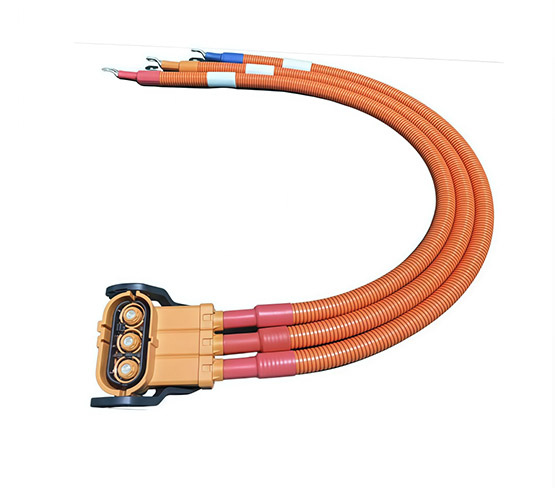
The risk grows as the pack gains more cells, branches, and service interfaces. A new energy vehicle power battery wiring harness has to keep low-current sensing paths orderly beside higher-energy hardware. That is why an electrical drawing alone is not enough; the production harness needs a repeatable way to preserve sequence, polarity, and connector orientation from cell group to BMS port.
The Signal Path Must Stay One-to-One
A reliable sampling path begins with a one-to-one relationship between the cell tap, the conductor position, and the BMS channel. That relationship sounds obvious, yet it is exactly what becomes fragile when a pack uses similar-looking leads, short branch spacing, or last-minute packaging changes. A battery wiring harness should make the correct path easy to trace before the pack is closed and hard to disturb during later handling.
Sequence control is more useful than visual similarity
Sequence control turns a bundle of wires into an auditable connection. Numbered sleeves, consistent branch order, and keyed terminals give assemblers a way to compare the harness with the pack map without relying on memory or wire color alone. This matters especially where neighboring cell taps are physically close but electrically very different.
For battery protection boards, Songyuan wiring harness builds data acquisition lines for lithium battery packs with JST, PH, XH, and related interface options. The useful point is not the connector name by itself. The connector, terminal, lead length, and identification method must work together so the installed harness retains its intended channel order.
A practical review before pack closure
*Confirm that the first and last sensing positions match the approved cell-string map.
*Compare every branch label with the BMS port designation before mating the connector.
*Check that strain relief and routing leave no branch under constant pull or a sharp bend.

Where Harness Design Protects Measurement Quality
Measurement quality depends on more than the BMS electronics. A battery cable assembly that is well organized can reduce the chance of a lead being pinched, pulled, or misidentified during module installation. Fine sensing conductors also need sensible routing away from avoidable mechanical stress and clearly protected at the points where they enter connectors, clips, or pass-throughs.
The table below keeps the discussion focused on false readings rather than turning the harness into a specification sheet.
|
Observed issue |
Likely harness cause |
Useful confirmation |
|
One cell reads implausibly |
Tap sequence or polarity does not match the BMS channel |
Trace the labeled branch from cell position to connector cavity |
|
Value jumps during vibration |
Terminal retention, branch support, or strain relief is weak |
Inspect crimp seating and support points before replacing electronics |
|
Several readings shift after service |
A connector was re-mated without a clear position check |
Verify keying, port label, and harness orientation together |
A new energy vehicle wiring harness is easier to service when its sensing branches remain distinct from high-voltage power routes in both layout and identification. This does not mean every lead needs a complicated solution. It means the assembly should give technicians a clear physical story: where the signal begins, where it travels, and where it is expected to terminate.
For projects that combine battery, inverter, and motor interfaces, an new energy vehicle wiring harness can be planned around the pack layout instead of being adapted after the connectors have already been chosen.
What to Clarify Before a Data Harness Is Built
The most valuable clarification is the signal map, not a generic description of the pack. A harness supplier needs the actual string count, connector cavity definition, branch locations, BMS port orientation, and the expected installation path. Those details determine whether a battery pack cable can be made with enough identification and mechanical support to prevent avoidable rework.
It also helps to distinguish voltage-sensing branches from temperature leads and communication branches early. Their functions may meet at the BMS, but they should not be treated as interchangeable during assembly. Keeping those roles visible in the build information makes a later fault investigation much shorter and reduces the temptation to test by trial and error.
Songyuan wiring harness’s battery wiring harness support can be matched to a defined BMS interface and pack layout, including conductor, insulation, terminal, and marking choices that suit the actual application rather than a generic connector list.
The Practical Takeaway
False cell readings are often treated as an electronics problem first, yet the signal path deserves the same discipline. A good BMS data acquisition harness preserves one-to-one mapping, protects fragile sensing branches, and gives the assembly team a visible way to confirm the path. When the pack map, connector cavities, and branch identification agree, the BMS has a far better chance of receiving data it can trust.
FAQ
What does a BMS data acquisition harness measure?
It carries individual cell-voltage and temperature signals from the battery pack to the BMS or protection board. Its job is to preserve the correct relationship between the measured point and the BMS channel.
Can a loose terminal cause a false cell-voltage reading?
Yes. An unstable terminal connection can interrupt or vary the sensing path, which may appear to the controller as an implausible or changing cell value. The harness and terminal should be checked before assuming the cell itself has failed.
Why are labels important on a battery pack cable?
Labels turn the intended cell-to-channel sequence into something an assembler or technician can verify. They are particularly useful when adjacent leads share similar colors, lengths, or connector families.
Is a battery cable assembly only for high-current power transfer?
No. The term can also describe lower-current interconnects used for sensing, control, or communication. In a BMS application, the critical value is reliable signal mapping rather than power capacity.


notizie correlate
-
 How Does a Medical Wire Harness Fail After Cleaning
-
 How Does a New Energy Vehicle Wiring Harness Control EMI?
-
How BMS Data Acquisition Harnesses Prevent False Cell Readings
-
 What Is a Medical Wire Harness?
-
 In che modo i cablaggi personalizzati supportano la progettazione di elettrodomestici intelligenti?
