
Automotive Wire Harness Standards for EV Sourcing
Time : October 14, 2026 View : 11
A certificate can leave an EV sourcing question unanswered. Does it cover the factory, the wire inside the assembly, or the materials used in a connector? For OEM teams and distributors, these distinctions determine what still needs checking before a harness enters production. IATF 16949, UL and RoHS serve different purposes, and each belongs beside the requirement it actually addresses.
Three different layers of automotive compliance
IATF 16949 addresses automotive quality management. UL appliance wiring material recognition addresses a defined wire construction and its intended ratings. RoHS restricts certain substances in electrical and electronic equipment within its legal scope. Together, they can inform a sourcing review, but they do not create one universal approval for an assembled harness.
The distinction is especially useful for a high voltage wire harness connecting an EV battery, inverter or motor. Its insulation and connectors must suit the selected circuit. A factory certificate alone cannot establish that suitability, while a recognized wire still needs correct termination and assembly. Each layer therefore requires a separate question.
IATF 16949 covers the manufacturing system
IATF 16949 is an automotive quality management system standard aligned with ISO 9001. Customer-specific requirements remain part of the automotive framework. For sourcing teams, the practical task is to verify that a current certificate covers the relevant manufacturing site and activities, then identify the vehicle customer’s additional requirements.
An automotive wire harness also needs records that connect the approved design with production. Ask how the drawing revision, terminal selection, crimp settings, inspection results and lot identification stay linked. These are useful review questions; a system certificate does not establish the electrical or environmental performance of a particular assembly.
Supplier scope and product scope should remain separate during review. After the manufacturing system has been checked, the next question concerns the actual wire entering that system: its construction, rating and permitted use.
UL ratings belong to a specific wire construction
ANSI/UL 758 covers appliance wiring material, commonly called AWM. Its evaluation depends on the construction and intended application, including voltage, temperature, flame performance and environmental exposure. A buyer should match the manufacturer’s recognition record and AWM style to the wire being ordered. UL Product iQ provides certification records for this verification.
Two wire ratings can illustrate why scope matters. Songyuan wiring harness offers a UL1007 electronic-wire range specified at 300 V and 80°C. Those values help identify that particular wire family. They do not establish suitability for an EV traction circuit operating above its rating, or certify an entire harness assembled with it.
Component recognition also has a supply-chain dimension. UL’s Wiring Harness Traceability Program monitors recognized wiring materials as they pass through harness production into final assembly. Buyers should verify any claimed participation and the covered materials. Once the electrical construction is identified, material restrictions become a separate review.
RoHS scope changes the material question
RoHS evaluates restricted substances rather than current capacity or crimp quality. Directive 2011/65/EU sets limits by weight in homogeneous materials: generally 0.1% for lead and 0.01% for cadmium, subject to applicable exemptions. A whole-harness average is therefore the wrong basis for judging those limits.
Vehicle use requires a scope check before treating RoHS as mandatory. Article 2 excludes means of transport for persons or goods, with a specific exception for electric two-wheel vehicles that are not type-approved. A passenger-EV harness should therefore be assessed against applicable automotive substance rules and customer requirements, rather than assuming RoHS automatically governs it.
A customer may still specify RoHS material limits contractually. In that case, the declaration or testing should identify the ordered parts and material scope, including relevant insulation, connector polymers and plating. Any claimed exemption needs its own justification. This keeps a material statement separate from vehicle approval and from mechanical or electrical qualification.
EV configuration determines the remaining evidence
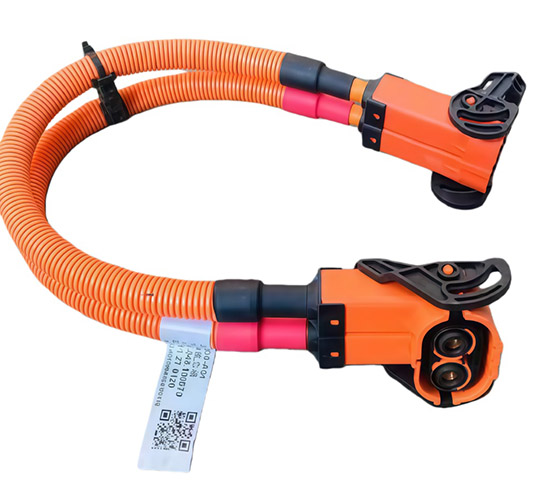
A configurable EV assembly makes the limits of certificates concrete. Songyuan wiring harness offers the following ranges for its high-voltage wire and cable assembly for new energy vehicles. Each figure describes a customization range, not a claim that every combination is valid or that one assembly reaches all endpoints simultaneously.
|
Assembly parameter |
Available range |
Meaning for the review |
|
DC voltage |
600–2000 V |
Confirm the selected insulation and connector ratings. |
|
Current and conductor area |
50–800 A; 6–150 mm² |
Confirm the chosen pairing and its operating conditions. |
|
Ingress protection |
IP67–IP68 options |
Obtain evidence for the selected assembled configuration. |
These ranges show why the approved part number must be more precise than the product family. A 300 V wire record cannot establish a 1000 V assembly rating. Likewise, an available IP option needs test conditions and configuration evidence; the option name alone does not prove the finished connection’s performance.
For a arnés de cableado personalizado, keep the interface drawing, conductor choice, insulation, connector and protection option under one revision. Request the relevant electrical and environmental qualification records for that revision. A later material or connector substitution should trigger a review of affected evidence before the changed assembly is released.
A sourcing decision tied to the actual assembly
A defensible EV sourcing decision connects the manufacturing system, recognized components and applicable material requirements to one approved configuration. The useful outcome is a clear account of what each certificate covers and which product tests remain necessary. Review the intended circuit and interface drawings with the supplier before accepting family-level claims as part-specific evidence.
Preguntas frecuentes
Does IATF 16949 certify an individual harness?
No. It concerns the automotive quality management system. A particular harness still needs design, inspection and qualification evidence appropriate to its vehicle application.
Does UL-recognized wire approve the complete vehicle?
No. Recognition applies to the defined component construction and use. The assembled harness and vehicle require the assessments applicable to their own scope.
Is RoHS mandatory for every EV harness?
No. Transport exclusions and the specific product application matter. Review automotive substance obligations and any contractual RoHS requirement for the destination market.
Can one rating describe every configurable harness?
No. Voltage, conductor area, current and connector options must be confirmed together. Product-family ranges do not prove every possible combination is qualified.
What should happen after a material substitution?
Review the affected wire recognition, material declarations and assembly qualification. Update the configuration records and obtain any customer approval required by the program.